The pH-auxostat couples the addition of fresh medium
to pH control. As the pH drifts from a given setpoint, fresh medium is
added to bring the pH back to the setpoint. The rate of medium addition
is determined by the buffering capacity and the feed concentration of the
limiting nutrient and not directly by the setpoint (pH) as in a traditional
auxostat.
The pH-auxostat is robust but controls nutrient concentration indirectly. The pH change is often an excellent indication of growth and meets the requirements as a growth-dependent parameter as defined by Fredrickson et al. (Ref. 1). However, the exact cause of pH change varies among organisms. It represents the summation of the production of different ionic species and ion release during substrate uptake. Therefore the pH can move either up or down as a function of growth. The most common situation is pH depression because of organic acid production and ammonium uptake. However for microorganisms growing on protein or amino acid-rich media, the pH will rise with growth because of the release of excess ammonia.
The pH-auxostat was simultaneously reported by different research groups and was probably first operated in the 1960's (Ref. 2 and 3) and a detailed development was presented by Martin and Hempfling (Ref. 4).
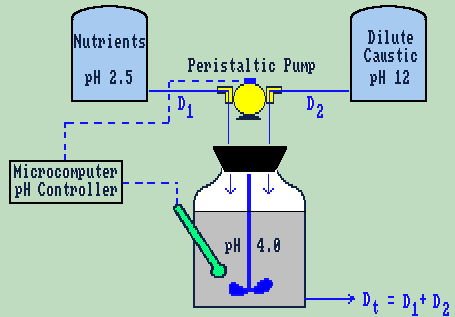
A typical set up as used by our group is:
Using two reservoirs at different pH expedites changing
the buffer capacity simply by changing the proportions. Selecting new pumping
rates changes the buffering capacity.
References:
Fredrickson, A.G., Megee, R.D. and Tsuchiya, H.M. (1970) Mathematical models for fermentation processes. Adv. Appl. Microbiol., 13, 419-465.
Bungay, H.R., (1972) Continuous culture with proportional control of substrate concentration. in Proc. 4th Intern. Ferm. Symp.: Fermentation Technology Today, ed. G. Turui, pp. 117
Watson, T.G. (1969) Steady state operation of a continuous culture at maximum growth rate by control of carbon dioxide production. J. Gen. Microbiol., 59, 83-89.
Martin, G.A., and Hempfling, W.P. (1976) Method for the regulation of microbial population density during continuous culture at high growth rates. Arch. Microbiol., 107, 41-47.