installation and web project by Teri Rueb
(programming by In Choi)
Click here to see installation at SIGGRAPH 2002
"The Choreography of Everyday Movement"
envisions, as a topographical mapping, the culturally inscribed nature
of our everyday travels. Using GPS, the project seeks to render visible
our movement through the built environment of the city, revealing socio-political
and poetic patterns of traffic flow through the urban body. In these drawings
we see images as often as we detect the privileging of one route over
another, the concentration of movement through particular neighborhoods,
and the repetition and variation of a traveler's movement over time.
"The Choreography of Everyday Movement" takes process and performance
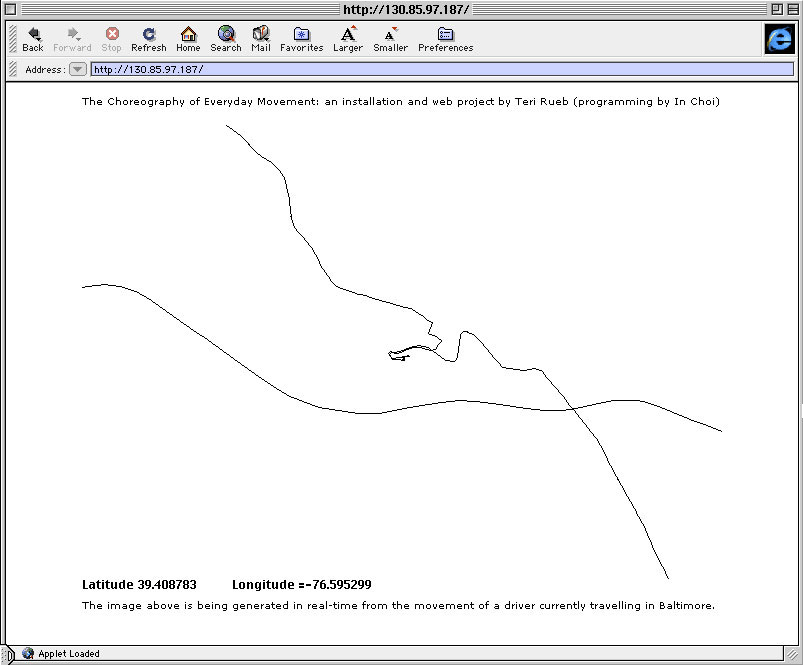
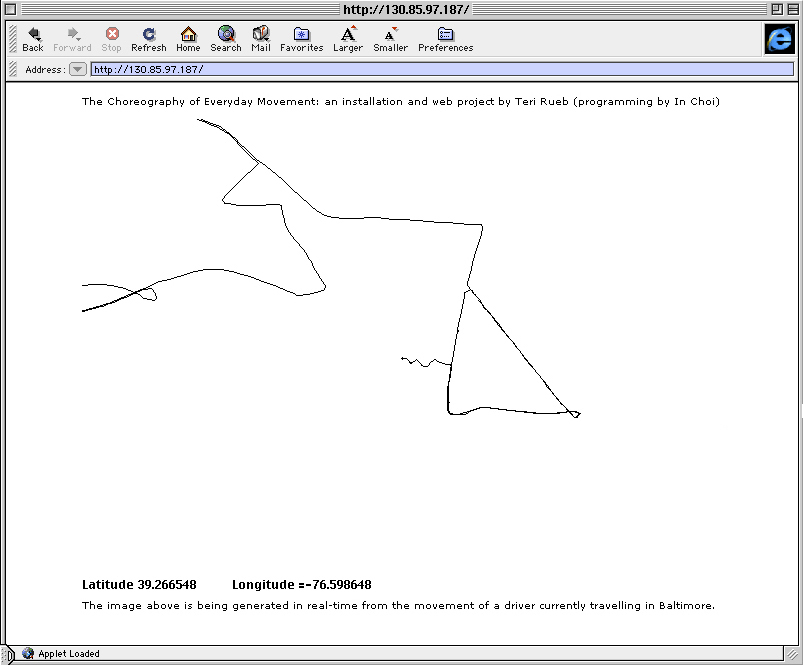
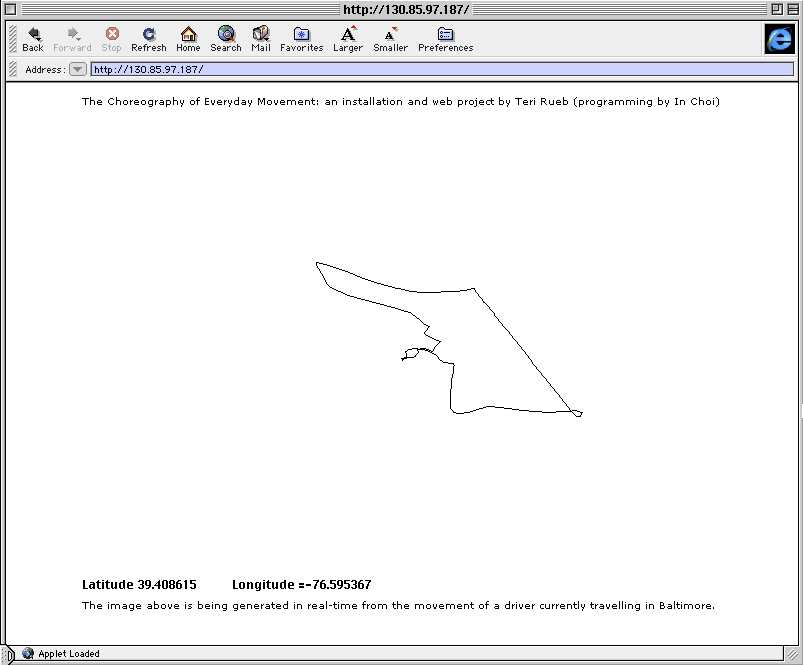
as the subject of the work. As a live element, participants are tracked
with global positioning satellite receivers as they move about the city.
The trail of each participant's movement is transposed into visual terms
as a dynamic drawing generated in real-time wirelessly over the Internet.
Drawings are then archived and presented for viewing in a three-dimensional
format. Each journey is printed on acetate, registered against prior journeys,
and sandwiched between stacked 1/2" plates of glass. The stacks of glass
grow taller over time with the addition of subsequent drawings, thus creating
an expanding "z-axis" through which the viewer can observe changes in
the movement of each traveler over time. The performance of the piece
requires no special expertise. Dancer/pedestrian, performer/spectator,
artist/non-artist ‚ each is equally capable of participating in the making
of the work.
Geographical reference data, present as longitude/latitude coordinates
in the real-time drawing, is removed in the final image so as to foreground
the expressive character of the line---a line upon which we project our
own interpretations. This one looks like a deer, that one like a figure
with arms stretching upward, legs intertwined. The global positioning
satellite receiver, designed for precise measurement and tracking, is
subverted and re-cast as a kind of giant pencil or tool for making chance
compositions. Marks that reveal the design of transportation grids become
compositions that engage the imagination like clouds in the sky.
The relationship of performer/spectator is re-configured in the real-time
generation of drawings over the internet. The performer is only visible
as an ant-like dot crawling across the screen. Movement and physical presence
are reduced to the most basic abstraction, yet we are amused by what appears
as a dynamic animation punctuated with moments of unintended physical
humor as the little dot stops at a traffic light or crosses over the path
of another performer. The performer is insulated from the gaze of the
spectator both in the moment of performance and in the recorded image
of that performance. The viewer never sees the body of the performer,
nor vice versa, creating a shifted and mediated economy of the gaze that
stands in contrast to traditional live performance.
Java applet and wireless integration developed by In H. Choi [2002 Graduate, UMBC, Computer Science and Imaging and Digital Arts]
This project was originally developed in the context of a group project funded by the Rosenberg Gallery at Goucher College (curated by Laura Burns). The project involved an 18-month dialogue between myself and Denise Tassin (painter), in collaboration with Goucher faculty and students (Amanda Thom Woodson, faculty / choreographer; Andrew Cole, student / composer; and Kirsten Maurer, student / dancer). It was presented with the participation of dancers from Amanda Thom Woodson's senior dance studio, Fall 2001.
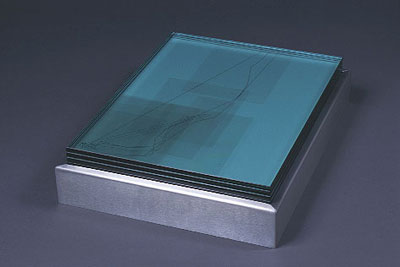
The Choreography of Everyday Movement: Dancer_1
GPS tracking of a dancer's travels around Baltimore
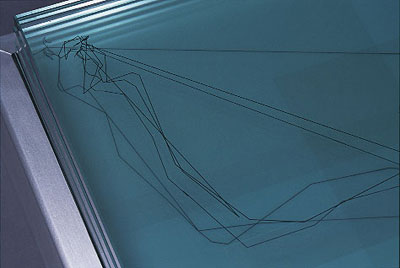
The Choreography of Everyday Movement: Dancer_1 (detail)
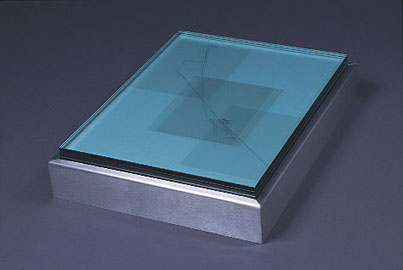
The Choreography of Everyday Movement: Dancer_2
GPS tracking of a dancer's travels around Baltimore
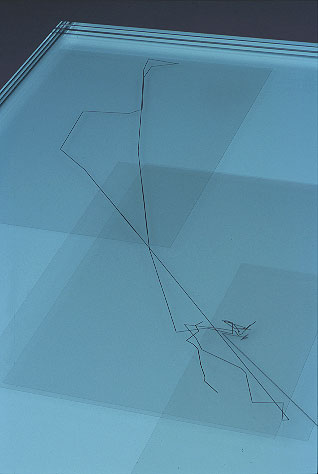
The Choreography of Everyday Movement: Dancer_2 (detail)