
Stable populations with variable traits
It is possible for the variability of traits to be stable over generations. This occurs when the population is at "genetic equilibrium". This term means that the proportion of each allele in the population does not change from one generation to the next. In a population at genetic equilibrium the proportion of each allele, its "allele frequency" is constant, and the proportion of homozygous and heterozygous individuals in the population can be predicted. This derives from the Hardy-Weinberg Rule.
In a population in which there are only two alleles at a given gene, where the frequency of one allele A is p, and the other a is q, the frequency of each of the three possible genotypes (AA, Aa and aa) is determined by this equation:

How is this equation derived?
We can think back
to the Punnett square used to describe a monohybrid cross:

The Punnett square in this case describes the probability of each type of offspring from the cross of two heterozygotes. The frequency of each of the alleles is the same in this cross; the probability that each parent will contribute A or a is the same, 50%. In this situation, the frequency of AA, Aa, and aa is 25%, 50% and 25%, as derived from the Punnett square (1/4 AA, 2/4 Aa, and 1/4 aa). This same conclusion can be arrived at using the Hardy-Weinberg equation if you assign the frequencies 0.5 to both p and q (although you should remember that Hardy-Weinberg describes the way a population behaves).
Frequency of AA = p x p = (0.5)(0.5) = 0.25
Frequency of Aa = 2pq = 2(0.5)(0.5) = 0.5
Frequency of aa = q x q = (0.5)(0.5) = 0.25
But what if the frequency of the two alleles is not equal, for example if the frequency of A is 0.7 and the frequency of a is 0.3. We can again use the Punnett square, but including the frequencies as well:
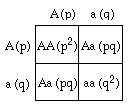
Given the values for p and q and the Hardy-Weinberg equation we can calculate the frequency of each genotype as 0.49 for AA (0.7x0.7), 0.42 for Aa (2 x 0.7 x 0.3), and 0.09 for aa (0.3 x 0.3). [Note that the three frequencies add up to 1 (0.49 + 0.42 + 0.9 = 1)].
Suppose a population of 1000 individuals with this frequency of alleles each produce two gametes. You would get:
980 A gametes from the 490 AA individuals
420 A gametes from the 420 Aa individuals
420 a gametes from the 420 Aa individuals
180 a gametes from the 90 aa individuals
Of the total of 2000 genes there are 1400 A and 600 a, for frequencies of 0.7 and 0.3 respectively, the same as the original allele frequency in the population. 2000 gametes could combine randomly to give 1000 individuals. 490 AA + 420 Aa + 180 aa, the same frequency as the first population.
In principal, this could continue for any number of generations, with the same population reproducing itself each time. This situation assumes five things:
- No genes are undergoing mutation (changes in allele frequency)
- The population is very large (sampling error)
- The population is isolated (changes in allele frequency)
- All members survive and reproduce (no natural selection)
- Mating is random
These assumptions essentially never occur in nature, so that the Hardy-Weinberg rule is in actuality an ideal, that is a hypothetical, situation to which a natural population can be compared to assess the factors which bias allele frequency.
