| The Clarinet of the Twenty-First Century - E. Michael Richards |
CHAPTER 7 - E-flat Clarinet
Vocalizing through the clarinet
Singing through the clarinet on various vowel sounds can create interesting formants (reinforced harmonics) when one lifts the fingers of either (or both) hand from their tone holes. The sound will change drastically between the following vowel sounds: ee, aw, o, and oo.
Example #10 (click on music for mp3)
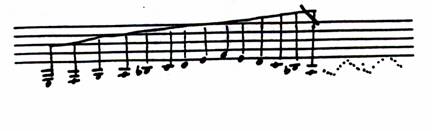
This sound is even more pronounced if the player takes more mouthpiece than normal into the mouth.
It is also possible to re-articulate this sound in an interesting way by pronouncing "le" with the tongue on the roof of the mouth. Other variations include adding a growl-like flutter or vocal portamento.
Further sounds that are possible to generate through the clarinet with the mouthpiece on are a barking sound ["(r)uff"] with a low E fingering, a slow laugh from the throat with a low E fingering, or a throat tremolo (ululation) "eh-eh-eh etc," (the way young children imitate a machine gun) which can be altered with a vocal portamento and/or by randomly moving the fingers of the right hand.
Through the E-flat clarinet (with mouthpiece off), it is also possible to produce an ingressive or egressive "vocal fry." Deborah Kavasch, a former member of the Extended Vocal Techniques Ensembles at the University of California , San Diego , describes this phenomenon:
Vocal fry is perceived as dry, clicklike pulses and is often used to imitate the opening of a creaky door. The pulse rate of vocal fry can be controlled to produce a range from very slow individual clicks to a stream of clicks so fast that it is heard as discrete pitch. It can be produced both egressively (exhaling) and ingressively (inhaling). The individual may find one mode easier to control than the other in terms of such parameters as pulse rate, dynamics, and pitch. The term "pitch," as used here in relation to vocal fry, refers to the range of perceived pitches rather than to any implication regarding the mode of phonation. 6
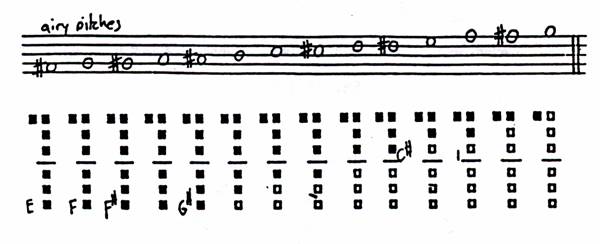
This effect is especially interesting when one moves the fingers of both hands, since very soft, airy sounds are apparent, in addition to the vocal fry (Example #11). These can be especially beautiful when amplified.
Example #11 (click on music for mp3)
for information on how to see/hear more E-flat clarinet resources, click here
|
||