| The Clarinet of the Twenty-First Century - E. Michael Richards |
CHAPTER 7 - E-flat Clarinet
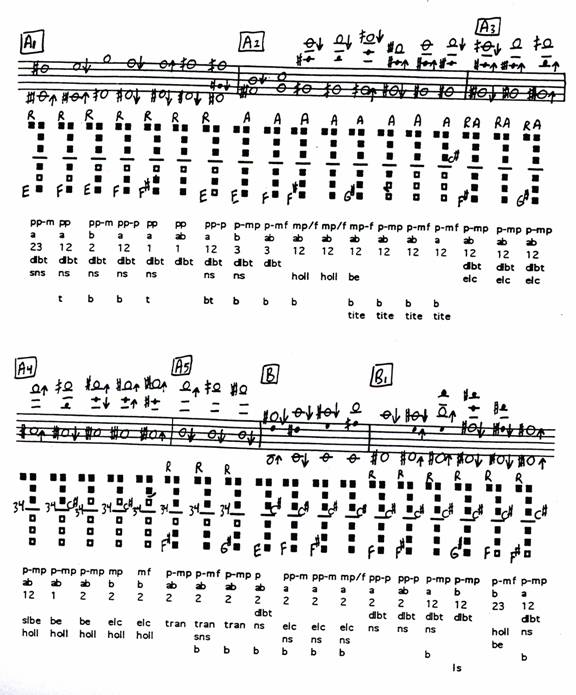
Chart of Multiple Sounds for E-flat Clarinet
The following chart (Table #12) has been compiled from numerous musical compositions, and experiments of the author; it has been checked for accuracy by other players. The author has striven to organize the material according to acoustic principles of the E-flat clarinet and basic principles of E-flat clarinet technique. All of the multiple sounds presented are playable on any traditional professional mouthpiece/reed set-up. They demand only slight deviations from normal finger expectations and embouchure. (while it is true that a multiple sound may be derived from any possible fingering for a single tone, of which there are theoretically thousands, this study omits those that require more than slight deviations in traditional finger expectations and embouchure).
Many previous studies have organized multiple sounds according to verbal descriptions of categories of production and/or tone color, regardless of acoustical relationships (i.e. derived from the same left hand vent hole). This study employs acoustical relationships as the first order of organization, and briefly describes characteristics of each multiple sound (see explanation of notation, below). Of course, every conceivable context for a particular multiple sound has not been discussed. The author wishes to reinforce the following advice: BE SURE TO CONSULT AN E-FLAT CLARINETIST ABOUT FEASIBLE CONTEXTS FOR PARTICULAR MULTIPLE SOUNDS.
Multiple sounds have been placed in groups (labeled by letter, beginning with those with the lowest fundamental); a common denominator within each group is an identical register/vent hole. In other words, the left hand fingering remains constant within a group (in most cases). The multiple sounds are ordered according to the right hand fingerings which ascend in chromatic or microtonal intervals. Care has been taken to insure that these groups are playable as sequences; this means limited (minimum) finger movement, and a lack of contrary motion, wherever possible.
A broken vertical line ( ) between multiple sounds in a group indicates that a legato connection is not possible, even though the adjacent sounds utilize the same series of partials. A double bracket ( ) between sounds in a group indicates that a legato connection is not possible, because the series of partials changes.
Groups of multiple sounds with the same letter label (i.e. D, D1, D2 etc.) utilize slightly different, but related left hand fingerings (different vents). For example, left-hand fingerings in Group D1 differ from Group D only through the addition of the register key. Left-hand fingerings in Group D2 differ from Group D only through the addition of side key #3. The close technical relation of these groups makes numerous trills and tremolos possible between them (discussed later). Left-hand fingerings for A represent the lowest bottom pitches - left hand fingerings for Y, the highest bottom pitches.
It is important to note that each multiple sound listed is available in isolation; it need not be connected to another. Various characteristics of each multiple sound have been described beneath each example in the chart. The format of this chart, top line to bottom line (underneath each multiple sound), is:
Line # information
I - dynamic range possible - pp to FF
II - stability: how stable is the sustain characteristic - a = very stable; b = moderately stable; c = unstable
III - response: the time required to produce all pitches of the multiple sound - how resistant is it?
1 = all sounds begin simultaneously, easily
2 = all sounds appear within 1 second, easily (somewhat resistant)
3 = all sounds appear within 2 seconds, resistant
4 = all sounds appear within 3 seconds, more resistant
5 = all sounds appear within 4-5 seconds, very resistant
IV - timbre: description of individual pitches of the multiple sound (all multiple sounds that use side keys 3 and/or 4 as register vents will have thin timbres)
tp = top
bt = bottom
dlbt = dull lowest pitch
dabt = dark lowest pitch (few higher partials)
fat = many partials (high and low)
thin = pitch is weak; lack of partials - lack of center
brt = bright; many higher partials
brtp = bright highest pitch
thtp = thin highest pitch
sub = subtone; dull
V, VI - texture: description of the overall texture of the multiple sound
- 2 general characteristics deserve mention here:
1) all diads (multiple sounds of two pitches which are produced as undertones) will contain a significant amount of air when played softly
2) most of the multiple sounds that are not undertones are capable of generating higher partials than indicated in the chart when played very loudly. However, the production and content of these partials are not controllable or reliable.
diad = two pitches (an undertone - lowest pitch is weaker than
the highest)
holl = hollow; high and low pitch (equal strength)
3vc = three voices
mvc = many voices
bal = balance; all pitches of equal intensity
elc = electronic; 3 or more pitches, thin timbres, acoustical beats
elc! = raucous electronic; changing amplitudes of pitches
(similar to electronic, otherwise)
be = acoustical beats; beats caused by out of tune intervals
slbe = slow acoustical beats
mud = muddy; unclear pitches
gent = gentle; dull timbres
M3! = predominant major 3rd (10th) or triad
ns = noise in the sound (air)
sns = some noise in the sound
VII - arpeggiation: capability to begin multiple sound with top or bottom pitch alone, gradually adding other pitches
t = easy to begin with top pitch
b = easy to begin with bottom pitch
bt = easy to begin with either top or bottom pitch
VIII - technique: hints for easier production
ls = looser embouchure, less air pressure
s! = very loose embouchure
tite = tighter embouchure, more air pressure
The notation system used in this chart for multiple sounds on the staff is one which the author hopes will become standardized. All pitches (or as many as possible) in the multiple sound should be written on the staff. The filled-in note-heads indicate secondary pitches, which may or may not be present according to the dynamic level of the multiple sound. It is important that the fingering for the multiple sound be indicated at every occurrence in the music, directly under the sonority. These procedures will greatly assist the clarinetist in learning the music.
Table #12 - Multiple Sounds
click on measure for mp3