
Samurai pose for "final" portrait.
History 459/659
Prof. Constantine Vaporis
Spring 2003, SS208
Office: Adm. 723 (455-2092)
Class hrs.: Wed. 7-9:45
Office hrs. Tu 9-9:50; W 2-3:30
email:vaporis@umbc.edu
www.research.umbc.edu/~vaporis
Guide to
this Webpage:
Course Description
Required
Texts and Other Readings
Organization
Grading
and Course Requirements
Term Paper
Note on Academic Honesty
Graduate
Student Requirements
Note
on Bibliographic Tools
Japan and the Web
Lectures and Readings
Web-based syllabus
Course Description:
Many have called Japan’s dramatic rise from the ashes
of WWII a “miracle.” Our purpose here is to examine the Japanese achievement
in an historical context, with the goal of trying to understand how
the miracle came about and what has happened to it in the last decade
or so. Beginning with Japan’s early modern past and the country’s forced
emergence from relative isolation, the course will explore Japan’s rise
as a modern state, its plunge into militarism and war, its subsequent
emergence as one of the world’s leading nations and its more recent attempts
to reform government and to revive the economy. Some of the more specific
topics of interest we will cover include the
impact of Japanese colonialism-imperialism in Asia, interpretations of the atomic bomb in Japanese and American
culture, the postwar legacy of WWII in Japan and abroad, the postwar occupation,
and Japan's contemporary economic and social "malaise."
Required Texts and Other Readings:
James L. McClain, Japan. A Modern History (2002)
David J. Lu, Japan. A Documentary History (1997)
Peter Duus, The Japanese Discovery of America. A
Brief History With Documents (1997)
Junichiro Tanizaki, Naomi (originally published
in serial form in 1924).
Frank Gibney, Senso. The Japanese Remember the Pacific War
(1995)
Laura Hein and Mark Selden, ed., Living With the Bomb. American
and Japanese Cultural Conflicts in the Nuclear Age (1997)
Richard Kim, Lost Names. Scenes From a Korean Boyhood
(reprint of 1988 edition)
Organization: Lecture and discussion format, supplemented with educational videos.
Grading and Course Requirements:
Midterm exam (3/12), 30%
Term paper (due 5/7 ), 15%
Participation and short writing assignments, 10%
Comprehensive final exam (5/21, 6-8 pm), 45%
Term Paper
You will have some choice in the type of term paper
or exercise you select. In all cases the paper should be 10-12 pages
in length (1" margins, 12-pt. font) and must adhere to the department
style sheet,
copies of which are available at Adm. 731 or on-line on the History
Department's web site. Unless otherwise specified below, your
paper topic must be submitted in my box (in Admin 732) by 3/12. All
papers are due 5/7.
You may either select one of the paper topics from a list attached here or alternatively, you may define your own topic. There are limitless possibilities here for you to develop a topic of interest. You may center your project on a protest movement, an industry, one or more works of art or buildings, a city, a natural or human-made disaster, etc. Students selecting their own topics must begin to think about them early in the semester and submit a proposal by 3/6 (one week earlier than those electing a prepared topic). This extra time may be necessary to refine or redirect your project. In all cases, the sooner you develop your proposal, the better!
Please note: the internet may not be used as a substitute for written sources!
Note on Academic Honesty:
By enrolling in this course, each student assumes the responsibilities
of an active participant in UMBC's scholarly community in which everyone's
academic work and behavior are held to the highest standards of honesty.
Cheating, fabrication, plagiarism, and helping others to commit these
acts are all forms of academic dishonesty, and they are wrong. Academic
misconduct could result in disciplinary action that may include, but is
not limited to, suspension or dismissal. To read the full Student Academic
Conduct Policy, consult the UMBC Student Handbook, the Faculty Handbook,
or the UMBC Policies section of the UMBC Directory.
Graduate Student Requirements: are required to fulfill all the course requirements noted above; term papers, however, should be of a length of 18-20 pages (again, text only), the topic for which should be chosen in consultation with the professor. In addition, graduate students should complete three books reviews, to be selected from a list of titles to be provided. A Useful guide to writing book reviews can be found on the Department web site under Tips for Research and Writing (itself under "Information for Students").
Note
on Bibliographical Tools:
Janet Hunter, Concise Dictionary of Modern Japanese
History (REF DS881.9.H86 1984) is quite useful and offers short
bibliographies for many entries.
Janet E. Hunter, The Emergence of Modern Japan. An Introductory History Since 1853 (1989) offers a topical approach to Japanese history (e.g., chapters on “Japan and Asia,”“Restoration and Occupation,” “Men and Women.”)
John Dower with Timothy S. George. Japanese History and Culture From Ancient to Modern Times: Seven Basic Bibliographies, 2nd. Ed. (1995) REF S835.D676 1986
Harry Wray and Hilary Conroy, ed., Japan Examined : Perspectives on Modern Japanese History (1983) consists of short historiographic essays on selected topics. Although many of the essays are far too short, this is a good starting point for examining various debates in Japanese history.
Cambridge History of Japan, esp. Vols. 3-6.
Kodansha Encyclopedia of Japan (2 sets of this
9-volume work, one in Reference and one in Stacks Folio, both referenced
at DS805.K633)
Major Journals:
Journal of Asian Studies, Monumenta Nipponica,Harvard Journal of Asiatic Studies
--available on
JSTOR (go to UMBC Library webpage and search under "Databases" for
JSTOR)
Bulletin of Concerned Asian Scholars
Journal of Asian History, Modern Asian Studies
The Journal of Japanese Studies
Japan and the
Web:
As you can imagine, the number of sites pertaining to
Japan on the web is seemingly limitless. This syllabus contains several
interesting suggestions for you. In addition, listed below are a few
sites for English-language periodic publications on contemporary Japan:
Weekly Post [Tokyo; weekly] : http://www.weeklypost.com
Japan Echo [Tokyo; bi-monthly]: http://www.japanecho.com
(translated commentaries by Japanese writers)
Japan File [Chuo-ku, Kobe; monthly]: http://www.kto.co.jp
Japan Times [Tokyo daily] http://www.japantimes.co.jp/
Asahi newspaper in English: www.asahi.com/english/english.html
Japan Insight--contemporary Japan site: www.jinjapan.org/insight/
The self-described “Mother of All Japan Links” (science,
technology, business, arts links):
http://home.earthlink.net/~myama/japan.htm
Hot links to more specific sites of historical interest can be found below.
Web-based Syllabus: The on-line version of this syllabus will be updated periodically.
Please use it as a resource. Your comments and suggestions are welcome
(please email me).
Week 1 (1/29): Introduction
No reading assignment.
Week 2 (2/5): Early Modern Society
James L. McClain, Japan. A Modern History, pt. 1 (Traditional
Japan), pp. 1-113.
David J. Lu, Japan. A Documentary History, pp. 273-81.
Focus: What made the Tokugawa “great peace” (taihei)
work?
Writing Assignment (1-2 pages, typed): Compare the treatment
of the Tokugawa period in the video viewed in class on 1/29 and the
McClain text.
Week 3 (2/12): Opening
to the West
Peter Duus, The Japanese Discovery of America,
skim 1-40, read 52-144.
Web assignment: Go through the Black Ships
Scroll ("Meet Sam" and "Sam's Tour") and write 1-2 paragraphs
on what these images tell us about this encounter between the Americans
and the Japanese.
Focus: What was the Japanese perception of the Western
threat? Why did Japan become of interest to the West? How did the “coming
of the West” in the 1850s affect the domestic political situation in
Japan?
Week 4 (2/19): Restoration and Revolution
McClain, Modern History, 119-206
Duus, Discovery, 145-84
Lu, Documentary History, pp. 295-343
On-line document: Meiji Constitution
(Lu, Documentary History, pp. 334-43 contains contemporary commentaries
on the Constitution but please see the web site above for the entire
document.)
Focus: Was the Meiji Restoration a “restoration,” “renovation,” “revolution” or a case of “defensive Westernization”? What did Fukuzawa and other Japanese travelers abroad think about the West? What did they see as its strengths and weaknesses?
How would you characterize the Meiji Constitution:
democratic? authoritarian? Or what? What rights do the people have? What
checks and balances are built in? In what ways did the constitution encourage
or hinder the growth of parliamentary democracy?
Samurai pose for "final" portrait.
Week 5 (2/26): Meiji Society & Culture
McClain, Modern History, 207-75
Lu, Documentary History, 343-51, 353-73
Tanizaki Junichiro, Naomi (complete). Reading questions
for Naomi.
Focus: What were the social costs of modernization?
What role did the state play in the process? How was the tension between
Japanese culture and modernity accomodated in Meiji (and Taisho) Japan?
(Discussion of Naomi)
Web sites of interest: Meiji Mura (Meiji Village), a Jurassic Park type theme park of Meiji period buildings moved from all over Japan to this remote area in central Japan. Of particular note is the front lobby to Frank Lloyd Wright's Tokyo Imperial Hotel. Examine the variety of buildings in different sections of the park. How have Japanese and Western cultures been accomodated in the buildings?
On the impact of Western culture on Japanese art you may want to visit the website "Japanese Art and Western Influence.
Nishiki-e (woodblock print) of the Ginza
Week 6 (3/6): Early Imperialism
McClain, Modern History, 278-315
Lu, Documentary, 351-53, 382-86
Tayama Katai, “One Soldier,” pp. 142-58 (available on
Blackboard under "Course Documents")
Begin reading Richard Kim, Lost Names. Scenes From a Korean
Boyhood (Reading questions
for Lost Names)
Focus: What was the nature of Japanese expansionism
in the late nineteenth and early twentieth centuries? What were the
principal forces propelling it? How did Japan's first two modern wars
(Sino-Japanese and Russo-Japanese) impact Japanese society and Japan's
standing in the international community?
Week 7 (3/12): Midterm Examination
Week 8 (3/19): Taisho Democracy and Interwar Society
McClain, 316-97
Lu, 375-82, 386-408
Focus: How "democratic" was Taisho Japan? What forces in Japanese society and in the world climate worked against democracy?
Spring Break: No class 3/26

Week 9 (4/2): Japanese Colonialism and the Dark Valley
Richard Kim, Lost Names. Scenes From a Korean Boyhood
(complete)
Gibney, 169-200
McClain, 405-70
Focus: How repressive was the wartime state? How would you interpret the 1930’s: militarism? fascism? conservatism? Discussion of Lost Names.

Week 10 (4/9): Japan in China--the war and its legacy
Gibney, 59-122, 283-318
McClain, 470-515
Focus: What kind of “new order” did the Japanese
want to construct? How and why did Japan get involved in (and then bogged
down in) China?
Internet assignment (on the Rape of Nanjing):
Read a portion of Iris Chang, The Rape of Nanking (1998) and/or
listen to her speech--links are available
here and consider it in light of Japanese revisionist
accounts. Write a one-page reaction. You may
also use the on-line site "The
Nanjing Atrocities" and do the same. Why has this issue gained
so much attention more than a half-century after the fact?
Click here
to read about a new Japanese documentary, "Japanese Devils" (2000),
on Japanese actions in China. The film highlights the confessions of
fourteen veterans.
Week 11 (4/16): The Pacific War: From Pearl Harbor
to the Atomic Bomb
Hein and Selden, Living With the Atomic Bomb (esp. chapters
1-2, 4-5, 8-10)
Focus: Did the Japanese or Anglo-Americans bear greater responsibility for the outbreak of the Pacific War? Was the “road to Pearl Harbor” inevitable? What was the role of Emperor Hirohito in the war’s end?
Optional assignment: read portions of Douglas
MacEachin, The
Final Months of the War With Japan, CIA Intelligence Monograph, 1999,
and write a one-page entry on how this declassified material adds to
our understanding of the end of the Pacific War.
Week 12 (4/23): Occupation and Reconstruction
McClain, 523-75
Gibney, 263-81
Lu, 453-504
Document: Japan's Postwar ("American"/"MacArthur") Constitution
Focus: What were the aims and goals of the Occupation? Did it
alter the course of Japanese history? (How different are prewar and postwar
Japan?) To what extent did the Japanese influence or shape the process? Compare the two constitutions. How much did the new constitution
meet the realities of postwar Japan?
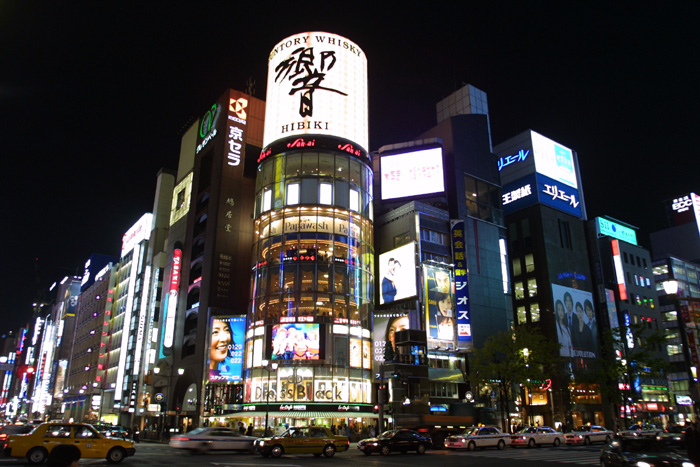
The Ginza Today
Week 13 (4/30): Postwar Society (1)
McClain, 563-75
Lu, 505-62
Week 14 (5/7): Postwar Society (2)
McClain, 576-632
Lu, 563-604
FINAL EXAM: 5/21 (Wed), 6-8 pm
Summer Vacation!